The Mat Is Not the Test: Seven UK Practice Grounds That Tell You the Truth About Your Seven Iron
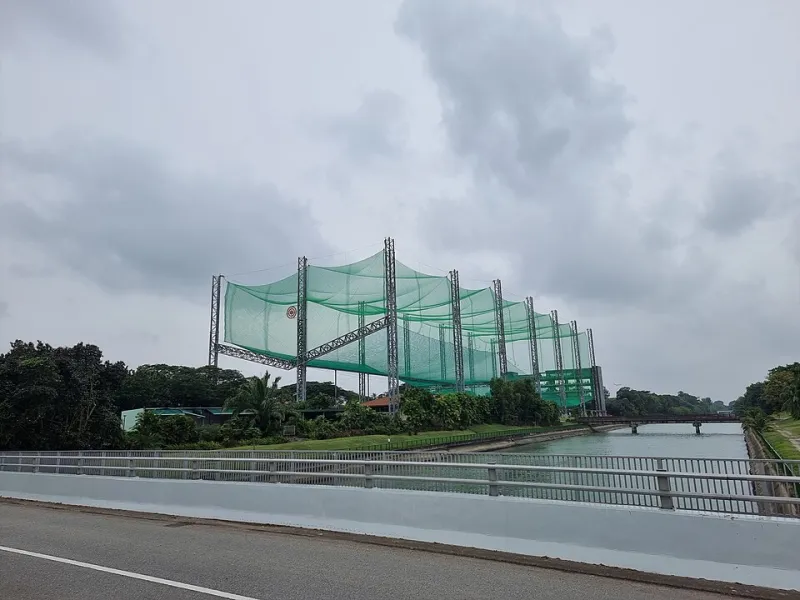
Photo: Kbseah, CC BY-SA 4.0, via Wikimedia Commons
There is a particular sound a seven iron makes off a mat in February. It is a crisp, satisfying click that tells you almost nothing. The mat has saved the strike, the bay has killed the wind, and the ball has flown to a distance that exists only indoors. Then you get to the course, put the same swing on wet turf, and wonder where your carry went.
If you want to know what your seven iron is actually doing in 2026, you need a practice ground with grass under the ball, a target worth aiming at and a bit of British weather in your face. These seven UK facilities are worth the drive. Check grass-tee availability and opening hours before you go, because winter schedules move around.
What Makes a Practice Ground Worth the Trip
A good practice ground does not need a robot, a screen or a leaderboard. It needs four things: turf that reacts like the course, targets that give you a number to chase, short-game areas that let you test the clubs around your seven iron, and enough exposure to wind that you cannot pretend it is not there.
Before you pay, ask one question: are the grass tees open? If the answer is no, you are back on the mat. That is fine for a warm-up, but it is not a proper seven-iron test.
1. St Andrews Links Academy, Fife
The Links Academy is the obvious place to start because the wind does half the coaching for you. The covered bays are useful, but the grass tees and target greens are the reason to visit. You get a clear view of ball flight and a breeze that turns a stock seven iron into a different club entirely.
Seven-iron test: Hit ten balls at your normal carry, then ten more into the wind with a lower finish. Do not change clubs. Learn what your seven iron can do when the ball is back and the hands are ahead. The Academy also has short-game areas, so finish with a few low seven-iron chips from tight lies. That is a shot most club golfers never practise and badly need.
2. The Belfry PGA Academy, Warwickshire
The Belfry's academy is a proper year-round facility, with covered bays and grass tees when conditions allow. The target greens give you something to aim at rather than a blank white wall, and the short-game area is good enough to spend an hour without looking at your watch.
Seven-iron test: Use the targets for a three-club ladder. Hit your seven iron to the middle flag, then try to land the same club short of the front target and long of the back one. This is not about smashing it. It is about controlling carry. Most weekend players have one seven-iron distance. A good session should give you three.
3. Formby Hall, Merseyside
Formby Hall has a practice range and short-game setup that suits a full afternoon. The coastal air can make the ball behave honestly, and the grass tees are the place to check whether your usual draw has turned into a leak when the turf is damp.
Seven-iron test: Put a headcover or towel down as a mini target and hit five balls from a bare lie, five from a fluffy lie and five from a slightly plugged lie. Your seven iron will produce three different flights. That is not a fault. It is information. Use it on the course instead of trying to hit the perfect number every time.
4. Close House, Northumberland
Close House has a strong practice setup with a range and short-game facilities that are worth seeking out in the north-east. The advantage here is space and a bit of elevation, which helps you see the start line of your seven iron rather than guessing from a bay.
Seven-iron test: Shape the ball. Hit five straight, five with a slight draw and five with a slight fade. You do not need to be a shot-maker. You need to know which one is your natural shot under pressure. If the fade keeps turning into a slice, your seven iron is telling you something about the face, not your ability.
5. The Shire London, Hertfordshire
The Shire London is a useful option for golfers in and around north London who want more than a plastic mat and a distance screen. The range and practice areas give you room to work, and the grass tees are the place to test whether your indoor numbers survive contact with actual turf.
Seven-iron test: Warm up on the mat, then move to grass and hit your first ten balls without a launch monitor. Pick a target, call the shot out loud and commit. The gap between your indoor carry and your grass carry is the number you should actually use on the course. It is usually smaller than you think, but it is never exactly the same.
6. Celtic Manor Academy, Newport
The Celtic Manor academy is a serious practice facility with covered bays, target greens and short-game areas. It is the kind of place where you can build a proper session rather than just hitting balls until your hands hurt.
Seven-iron test: Play a virtual three-hole loop. Pick three targets on the range and treat each one as a fairway. Hit seven iron off the tee, then a second seven iron to a smaller target. Change the wind by moving to a different bay if you can. This is the closest a range gets to the mental challenge of the course.
7. Gleneagles Academy, Perthshire
Gleneagles is a treat, but the academy is not just for tourists. The practice facilities are excellent, and the grass tees give you a proper sense of strike from the first ball. The surrounding trees and hills also make the wind easier to read than on a flat, open range.
Seven-iron test: Hit your seven iron from an uphill lie, a downhill lie and a flat lie. Most club golfers never do this, then act surprised when the ball comes out low on a downslope. Use the academy to learn what your seven iron does when the ground is not perfect. That is the shot you will face on a Saturday morning in November.
How to Make It Transfer
The secret to a good practice-ground session is not volume. It is consequence. Give every shot a target, a shape or a lie. If you hit twenty balls with no intention, you have just exercised. If you hit twenty balls with a specific seven-iron job, you have practised.
Take one notebook. Write down your carry into the wind, your carry downwind and your stock carry from a flat lie. Then take those numbers to the course and trust them. The mat is not the test. Grass, wind and a target are the test. Your seven iron is ready for it.