One Club, Seven Shots: A Seven-Iron Short Game Syllabus for Wet Grass
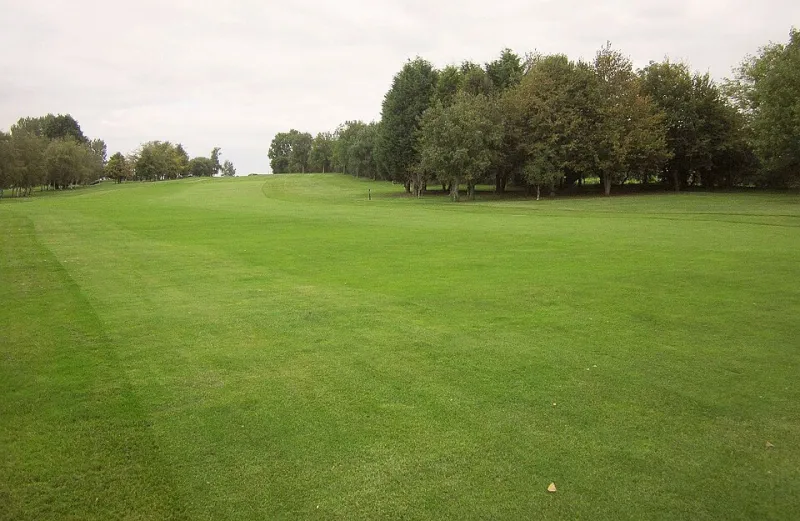
Photo: Derek Harper , CC BY-SA 2.0, via Wikimedia Commons
Every winter, the same thing happens on the practice green. Someone arrives with a bag full of wedges, tries to nip a lob off a soggy lie, chunks it four feet, and mutters something about the ground being wet. The ground is always wet. That is not the problem. The problem is choosing a club that needs firm turf to work.
Your seven iron needs nothing. It has a flat face, a bit of bounce, a low centre of gravity and a shaft short enough to control. Around a UK green in November, that is a more useful set of properties than any wedge in your bag. What follows is a short syllabus: seven shots, one club, all of them built for slow greens and soft lies.
A word before you start. The theme running through all seven is the same — quiet hands, weight forward, and a landing spot picked before you take the club back. If you take one thing away, take that.
Shot 1: The collar putt
Ball just off the green on the fringe, nothing in the way, flag maybe eight yards on. Grip down to the metal, stand as you would for a long putt, and make a putting stroke with the seven iron. Toe down slightly, hands neutral, no wrist at all.
The ball hops once, twice, then rolls like a putt. This is the most underused shot in club golf and it works beautifully on slow winter surfaces, because the ball is not asked to check. It just needs to start on line.
Shot 2: The fringe bump-and-run
The classic. Ball back of centre, hands ahead, weight on the front foot, feet close together. Pick a spot a third of the way to the hole, land it there, and let the club's loft do the arithmetic.
A seven iron at moderate speed will run roughly three to four times as far as it flies on a soft green. On a dry summer green it might be five. Learn your own ratio on the practice green and you have a shot you can use from twenty yards in for the rest of your life.
Shot 3: The forty-yard runner
Longer version of the same idea, but now you need a swing rather than a stroke. Three-quarter length, chest rotating, hands quiet. Land it around fifteen yards short and let it release.
Most club golfers hit this shot with a sand wedge and come up five yards short, every time. The seven iron removes the guesswork: less loft, more run, more margin for a slightly heavy strike. On a wet fairway approach to a green that is soft and slow, this is the percentage play.
Shot 4: The wet-rough escape
Ball sitting down in damp, clinging rough just off the green. This is where the seven iron earns its keep. Ball back, weight heavily forward, face slightly hooded, and hit down aggressively — a short, steep chop rather than a sweep.
The club cuts through the wet grass instead of sliding under it, and the ball comes out low and running. Expect it to release hard. Pick a landing spot well short of the hole and let it run out. Do not try to be clever here. The job is to get on the green, not to knock the flag out.
Shot 5: The mud-lie nudge
Winter golf's speciality: a bare, muddy lie with almost no grass under the ball. A wedge will bounce off the mud and thin it. A seven iron, played like a putt with a slightly descending blow, will pick it clean.
Choke down, stand tall, keep the strike small. The ball will come out hot and low. Allow for the run and aim at the middle of the green. This is not a shot to be proud of; it is a shot to be grateful for.
Shot 6: The wet-sand liner
Bunkers in January are usually compacted, wet and grim. A standard splash needs fluffy sand. You do not have fluffy sand. What you do have is a seven iron with a sharp leading edge.
Square the face, ball slightly back, and strike an inch behind the ball with a firm, descending blow. The club cuts through the wet sand and the ball comes out low, running hard. Get it out and onto the green — anything more ambitious in wet sand is a lottery.
Shot 7: The soft-landing flick
Sometimes you genuinely need the ball to stop — a front pin, a bunker between you and the flag, a green that runs away. This is the one shot in the syllabus that asks for a little wrist.
Open the face a fraction, use the bounce, and make a slightly longer, softer swing. The ball comes out higher than you would expect from a seven iron and lands softly. It will not check like a wedge, but on a damp green it will settle quickly enough.
How to practise all seven
You do not need a long session. Take one ball, your seven iron and a towel, and work around the practice green from four stations: fringe, twenty yards, forty yards, and a bad lie. Play each shot twice. Ten minutes, twice a week.
Keep a note of one thing — how far the ball ran out. After a month you will have numbers you can trust, and trust is the whole point. The seven iron is not a magic club. It is a predictable one, and predictable is exactly what club golfers need when the fairways are squelching and the greens are slow.